A 20-second version of your test brief: the camera glides through the cytoplasm past a mitochondrion and the rough endoplasmic reticulum, a vesicle travels along a microtubule toward the nucleus, then the view pulls back until the whole cell floats in front of us.
Sound on: one line of narration and a quiet documentary score.
I design the look as stills first, check them against the biology, and only then animate them. That keeps the style the same from shot to shot.
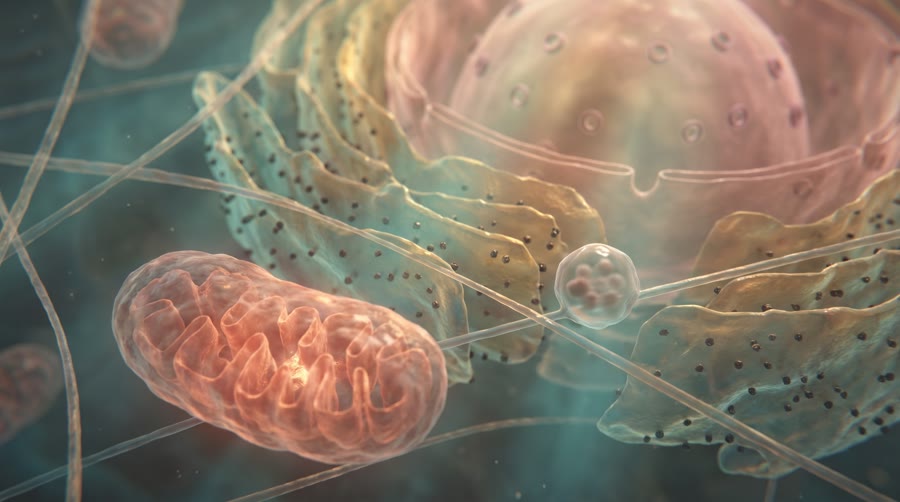
Inside the cytoplasmMitochondrion with cristae, rough ER with ribosomes, a vesicle on a microtubule, the nuclear envelope with pores behind.
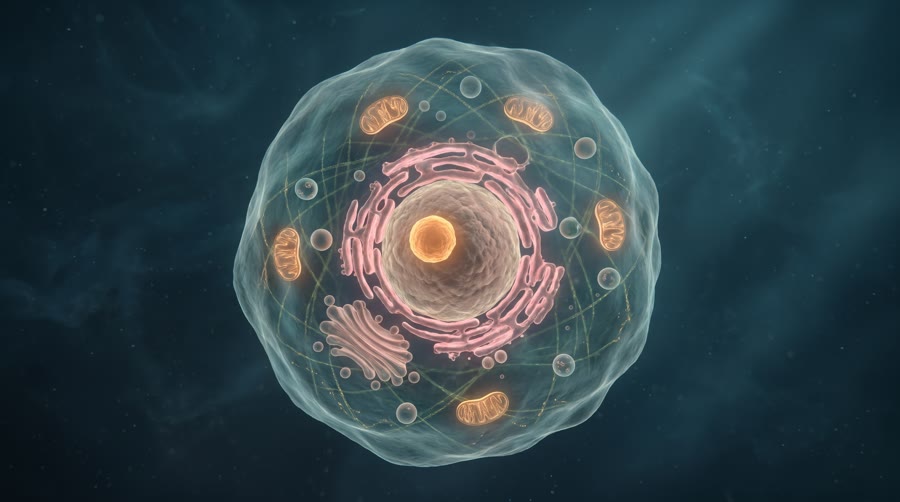
The whole cellNucleus with nucleolus, ER around the nucleus, Golgi stack, mitochondria, vesicles, cytoskeleton, plasma membrane.
Correct: the organelles, their basic shapes and where they sit relative to each other: cristae inside the mitochondrion, ribosomes on the rough ER, pores in the double membrane of the nucleus, vesicle transport along microtubules.
Artistic: the density. A real cytoplasm is far more crowded with proteins and filaments; I thinned it out so the eye can follow. The colours are a palette choice, not real colours, and in the whole-cell shot the nucleolus drifts a little as the cell turns. For a real episode I would agree the level of detail with your science advisor and correct anything they flag, shot by shot.
The narration line is accurate too: a typical human cell is about 10 to 30 micrometres across, a human hair about 70.